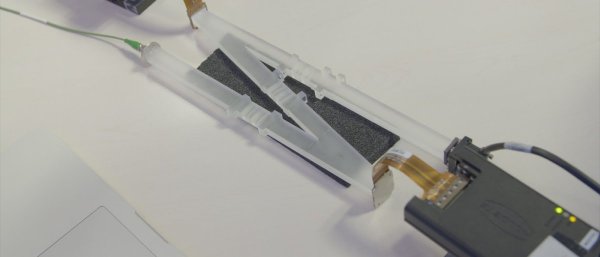
The U.S. Defense Advanced Research Projects Agency (DARPA) has awarded a $350,000 grant to Optalysys, a data-processing startup spun out of Cambridge, to advance its optical co-processing technology. The 13-month project, designated Project EQUATE, is designed to tackle the complex mathematical equations that underpin large-scale scientific and engineering simulations, including weather prediction and aerodynamic modeling.
Optalysys's approach replaces electrical signals with light in computer systems, a departure from traditional silicon-based architectures. The company says this method offers significant energy savings and the potential for dramatically increased processing speeds, with a long-term goal of reaching exaFLOP rates—a billion billion calculations per second. That performance level would far exceed current high-performance computing capabilities.
The grant comes as the industry confronts the limits of Moore's Law, the observation that the number of transistors on a dense integrated circuit doubles roughly every two years. With that trajectory flattening, researchers are exploring alternatives such as new semiconducting materials, quantum computing, and photonic or light-based systems.
Project EQUATE: Targeting Complex Simulations
Project EQUATE focuses on developing optical processing systems capable of handling high-end computational tasks, particularly in the field of computational fluid dynamics. The project specifically aims to support Direct Numerical Simulation (DNS), which models real-world fluid behavior with high accuracy, and Large Eddy Simulation (LES), a less computationally intensive method for fluid modeling. These techniques are essential for improving the dynamical core of earth systems models used in climate and weather forecasting.
Beyond EQUATE, Optalysys is pursuing other initiatives. Project GENESYS is developing a genetic search system for The Genome Analysis Centre, while Project ESCAPE is working on extreme-scale optical computing capabilities for European operational numerical weather prediction. These projects highlight the company's broader ambition to apply optical computing across scientific and engineering domains.
The DARPA funding underscores growing interest in photonic computing as a potential solution to the energy and performance constraints of conventional electronics. While the technology is still in development, the grant provides Optalysys with resources to refine its optical co-processing approach for real-world applications.
















Comments (0)