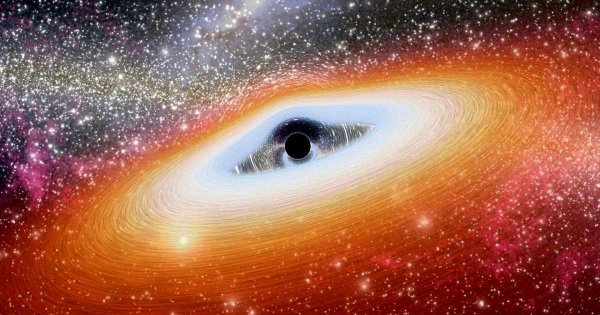
A team of European astronomers has identified an exceptionally rare type of black hole in a galaxy so distant that its light has taken nearly 12 billion years to reach Earth. The finding, published Tuesday in The Astrophysical Journal Letters, not only sets a new distance record for this class of object but also casts doubt on the widely accepted sequence of how galaxies and their central black holes evolve over cosmic time.
The object in question is a blazar—a supermassive black hole that emits powerful jets of gamma radiation directly toward Earth. This particular blazar belongs to a subtype known as BL Lacertae (BL Lac), and it is the most distant one ever observed. Because looking across vast distances in space is equivalent to looking back in time, the astronomers are seeing this galaxy as it existed when the universe was just 1.7 billion years old, a fraction of its current age of 13.8 billion years.
Why This Blazar Is So Puzzling
The problem lies in the galaxy's youth. According to current models, BL Lac blazars are thought to be the mature phase of a younger, more energetic type of active galactic nucleus called a Flat-Spectrum Radio-Quasar (FSRQ). In this evolutionary sequence, an FSRQ gradually transforms into a BL Lac over hundreds of millions of years. But this newly found BL Lac is far younger than any previously known, meaning it should not have had enough time to evolve from an FSRQ.
“This finding challenges the current scenario that BL Lacs are actually an evolved phase of FSRQ,” said study author Nicolás Cardiel of Spain's Complutense University of Madrid (UCM) in a press release. The discovery suggests that the evolutionary path of these powerful objects may be more complex—or entirely different—than astronomers had assumed.
A New Wrinkle in Cosmic Evolution
The research team, which used the Gran Telescopio Canarias (GTC) in Spain's Canary Islands, identified the blazar by its characteristic gamma-ray emission and then confirmed its distance through optical observations. The galaxy is so far away that its light has been traveling for nearly 12 billion years, meaning the black hole existed when the universe was only about 12% of its current age.
“This discovery has challenged our knowledge of the cosmic evolution of blazars and active galaxies in general,” said study coauthor and UCM professor Jesús Gallego in the release. The finding implies that at least some BL Lacs did not follow the predicted FSRQ-to-BL Lac sequence, or that the timescales involved are much shorter than previously thought.
Implications for Galaxy Formation
Blazars are among the most energetic phenomena in the universe, and their evolution is closely tied to the growth of supermassive black holes and the galaxies that host them. If the new observations hold up, astronomers may need to reconsider not only how blazars change over time but also how the earliest galaxies accumulated their central black holes.
The discovery also raises questions about the rate at which black holes can grow in the early universe. Finding a fully formed BL Lac blazar so soon after the Big Bang suggests that some black holes reached supermassive status much faster than current models allow. This could have implications for understanding the seeds of the first black holes and the role they played in shaping the galaxies we see today.
The team's next steps are likely to involve searching for more examples of these young BL Lacs to see if they are common or rare exceptions. If they turn out to be common, the standard model of blazar evolution will need a major overhaul. If they are rare, they may represent a special pathway that only a few galaxies take. Either way, the discovery provides a new piece of evidence in the ongoing effort to piece together the history of the universe.

















Comments (0)