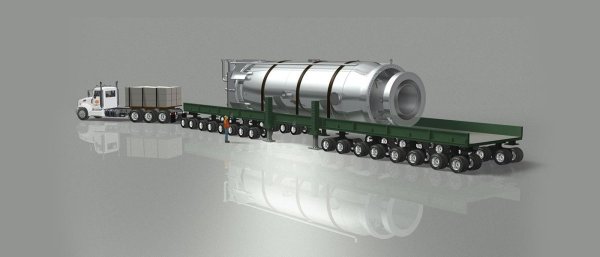
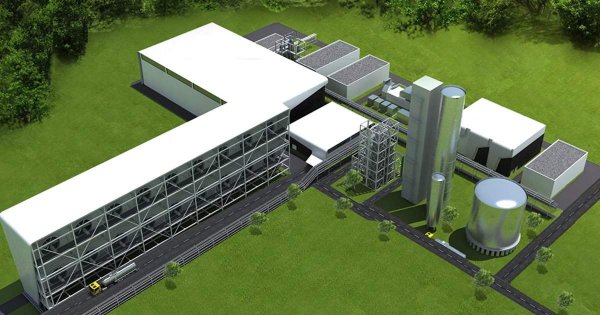
NuScale Power has submitted a design for a compact nuclear reactor that could fit on a flat-bed truck, a move that challenges the industry's conventional wisdom that bigger is better. The company's modular approach aims to reduce the footprint of nuclear plants from sprawling hectares to a nine-story structure, potentially lowering costs and safety risks.
The reactor, housed in a self-contained module, generates 50 megawatts of electricity using uranium fuel. Multiple modules would be assembled at a factory and then transported to utilities, where they would operate together. While the design still requires nuclear engineers, its smaller scale offers several advantages, including reduced uranium fuel needs and a lower risk of catastrophic meltdowns.
Safety is a key selling point. The uranium is enclosed in a containment vessel and submerged in water, and the system relies on natural convection for cooling, eliminating the need for pumps that failed during the Fukushima disaster. NuScale claims this makes the reactor safer and cheaper than existing plants.
To illustrate the cost difference, the company points to Tennessee's 1,150-megawatt reactor, which cost $4.7 billion and faced years of construction delays. In contrast, NuScale estimates a 570-megawatt project could be built for under $3 billion.
Potential Applications and Concerns
These smaller plants could serve as backup for wind turbines, providing power when winds are calm, or supply electricity to military bases during grid failures. However, not all experts are convinced. Ed Lyman, an analyst at the Union of Concerned Scientists, warns that scaling down the containment building and reducing the operating crew could compromise safety. NuScale's Chief Commercial Officer, Mike McGough, counters that the smaller system is inherently safer, reducing the need for traditional protective structures.
The design is now under review by the Nuclear Regulatory Commission (NRC), a process that could take about three years. If approved, NuScale hopes to have its first plant operational by 2026.











Comments (0)