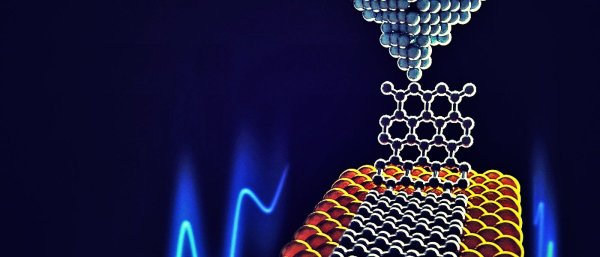
An international team of physicists has demonstrated that graphene, when dragged across a gold surface, exhibits almost no friction—a finding that could lead to ultra-thin coatings for mechanical parts, drastically cutting energy losses in machines. The research, led by Prof. Ernst Meyer of the University of Basel and involving scientists from the Swiss federal lab Empa, was published in the journal Science.
The team combined computer simulations with physical experiments to measure the interaction between graphene and gold at the nanometer scale. They anchored strips of graphene—known as nanoribbons, just a few atoms wide—to a sharp tip and pulled them across a gold surface, while also modeling the forces at play. The results confirmed that graphene's superlubricity, a state in which friction nearly vanishes, is even more pronounced than previously thought.
Graphene is already celebrated for its remarkable properties: it conducts electricity about 200 times better than silicon and heat about 10 times better than copper. Its electrons move at extraordinary speeds, behaving like massless photons. But this new work focuses on its mechanical behavior, specifically its ability to slide with minimal resistance.
Why Superlubricity Matters for Machinery
Friction is a major source of energy waste in engines, gears, and other moving parts. Reducing it not only improves efficiency but also extends the lifespan of equipment. The study suggests that graphene coatings could be applied in very thin layers to minimize energy loss, though the researchers note that friction cannot be entirely eliminated—only reduced to near-negligible levels.
According to the study, the nanoribbons—ranging from 5 to 50 nanometers in length—can be moved with incredibly tiny forces, just 2 to 200 piconewtons. That level of control opens up possibilities for manipulating materials at the nano level, which could have implications for nanoscale manufacturing and precision engineering.
“Our results help us to better understand the manipulation of chemicals at the nano level and pave the way for creating frictionless coatings,” the researchers wrote. While the immediate application is likely in industrial coatings, the broader impact could be felt in any field where reducing friction is critical, from microelectronics to biomedical devices.
The study is a collaborative effort between the University of Basel and Empa, combining experimental expertise with computational modeling. The team's approach—matching real-world measurements with theoretical predictions—adds confidence to the findings, which could guide future development of low-friction materials.
As industries worldwide seek to improve energy efficiency, this discovery offers a practical path forward. Though commercial applications may be years away, the fundamental understanding gained here is a crucial step toward harnessing graphene's superlubricity in everyday technology.















Comments (0)