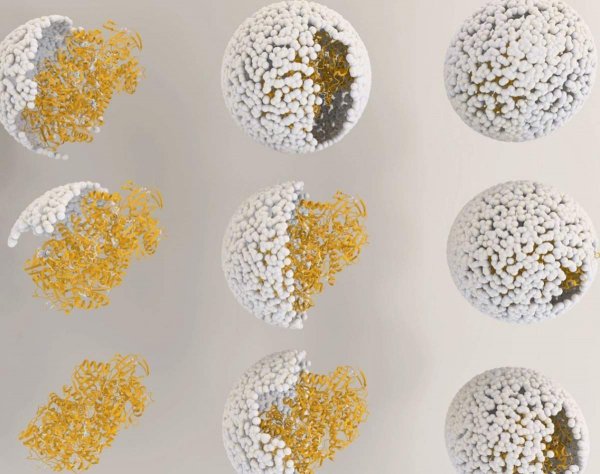
Scientists at Indiana University have modified a virus to protect a fragile enzyme that splits water into hydrogen and oxygen, resulting in a biomaterial that produces hydrogen 150 times more efficiently than the unaltered enzyme. The findings were published in the journal Nature Chemistry.
The biomaterial, named P22-Hyd, combines the protein shell of bacteriophage P22 with the enzyme NiFe hydrogenase. The enzyme is produced by combining the genes hyaA and hyaB in Escherichia coli bacteria through a simple fermentation process at room temperature.
"Essentially, we've taken a virus's ability to self-assemble myriad genetic building blocks and incorporated a very fragile and sensitive enzyme with the remarkable property of taking in protons and spitting out hydrogen gas," said Trevor Douglas, who led the study, in an IU Bloomington press release. "The end result is a virus-like particle that behaves the same as a highly sophisticated material that catalyzes the production of hydrogen."
Unlike its unaltered form, P22-Hyd resists degradation from environmental chemicals and can act as either a hydrogen production catalyst or a fuel cell catalyst depending on the circumstances. These properties suggest potential use in manufacturing and hydrogen fuel cells for cars.
The material is comparable to platinum in function but is renewable, biodegradable, and can be produced at room temperature on a massive scale using fermentation technology. "You don't need to mine it; you can create it at room temperature on a massive scale using fermentation technology; it's biodegradable," Douglas said. "It's a very green process to make a very high-end sustainable material."
The development comes as automakers shift away from gasoline and diesel toward renewable sources such as hydrogen fuel or electric batteries.










Comments (0)